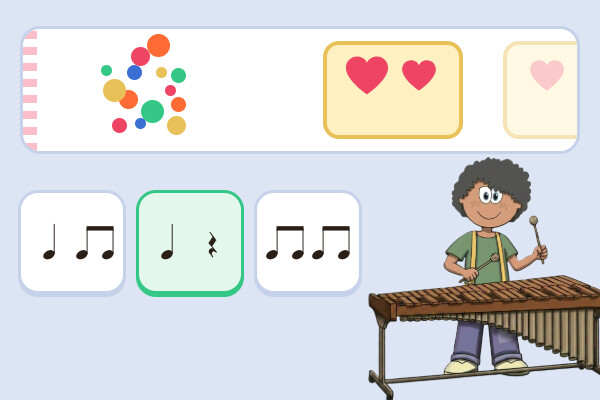
A rectangle with two hearts crosses the screen while a two-beat rhythm plays. Below are four options written in notation, and you have to press the one that matches what you hear. You do not play the rhythm: you recognise it by ear, as in a dictation, but with the friendly rush of a short-round game.
How it works
- Choose a level (or pick four rhythmic figures of your own) and the speed: slow, medium or fast.
- When you press «Start», a rectangle enters from the right and a two-beat rhythm starts playing, looping. The two hearts beat with the pulse, so the metre can be seen without explaining it.
- Below there are four buttons with written rhythms. Press the one that matches what you hear (keys 1 to 4 work too).
- Correct: the rectangle explodes and a new rhythm comes in. Wrong: the rectangle turns red, shows the right rhythm and plays it once more. No answer: if it reaches the finish line, it fades away and the next one follows.
- A round lasts 45 seconds. At the end, the result is rated by the percentage of correct answers.
Five levels, by rhythmic figures
Each level adds new figures and keeps the previous ones. The rhythms are always two beats long, combined with each other:
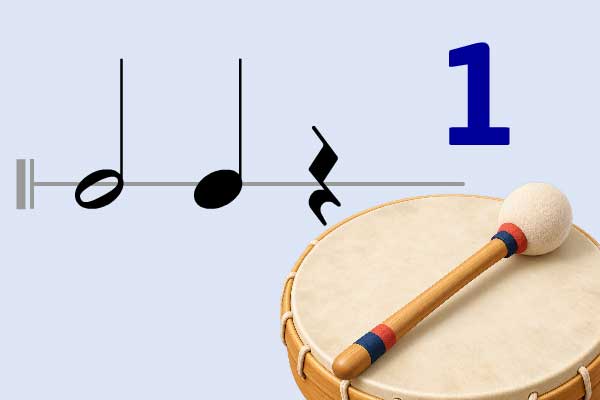
- Level 1 — Beginner 1. Quarter note, quarter rest and pair of eighth notes.
- Level 2 — Beginner 2. Four sixteenth notes.
- Level 3 — Intermediate 1. «Un-ti»: an eighth rest followed by an eighth note.
- Level 4 — Intermediate 2. Syncopation and «tai-ti» (dotted quarter note and eighth note).
- Level 5 — Advanced 1. Combinations of eighth and sixteenth notes: «ti-tiri», «tiri-ti» and «tim-ri».
In level 1 the four buttons come from its six possible rhythms. From level 2 on, each round mixes one rhythm from level 1, one from the previous levels and two from the new level, to practise what was just learned without forgetting the rest. The buttons do not change during the round.
Choose your own rhythms
Besides the five levels there is a free mode: you pick four figures from the full list and the round uses the rhythms that can be built with them. It is useful for reviewing exactly what is being worked on in class, or for setting up a tailor-made challenge.
Tournament Mode: two players, taking turns
For the interactive whiteboard, or pairs sharing one device: two players pass the device across three 45-second rounds of increasing difficulty, and whoever gets the most correct answers wins. There is a quick tournament (three consecutive levels, already calibrated) and a custom one (you pick the level of each round), with the same speed for both players. Free, with no limit on games.
What it trains
Linking what you hear with how it is written: each button is a rhythmic cell written with figures the students already know.
The hearts beat with the pulse. There is an optional metronome, off by default, for those who need extra support.
You do not play the rhythm or hit the exact moment: you recognise it by ear, so it does not depend on mouse or finger speed.
For the classroom
- Two-minute warm-up. One or two rounds of the level being worked on, at the start of class, with the screen projected and the group deciding by ear.
- Individual or in pairs. Each round lasts 45 seconds: a good self-directed practice corner, with headphones if several teams play at once.
- Progressive speed. Start slow and speed up when the correct answers settle; the crossing time is always the same number of beats, so the tempo changes, not the reading difficulty.
- Then, play it. After recognising them by ear, the same rhythms can be played with body percussion or with the tambourine in the game RhythmHop.