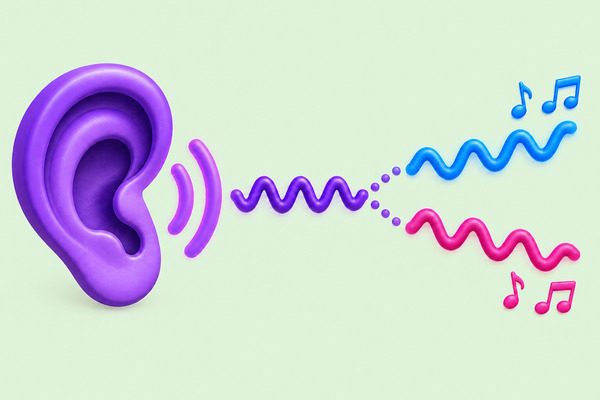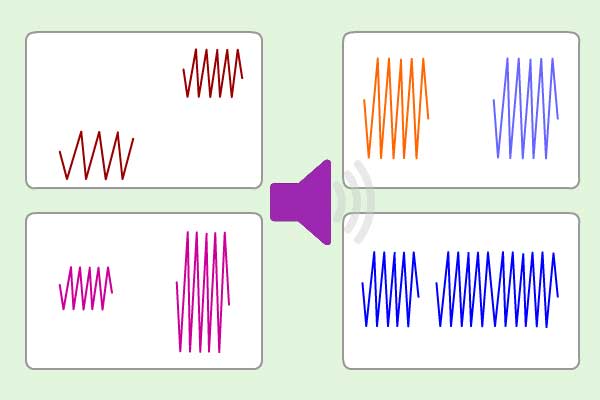
Two speakers play the same well-known tune — Happy Birthday, Frère Jacques, Jingle Bells… — but not quite the same way: one is higher, or louder, or has detached notes, or is played by another instrument. You have to find out what has changed. That way the four qualities of sound are learnt with the ear, not just with the definition.
The four qualities, as they sound in the game
The same tune, higher or lower: the game transposes the whole tune so it is not mistaken for a different song.
Played loud or played soft. All instruments are matched in volume, so a change of instrument does not sound like a change of intensity.
With the same beat, the notes are long and smooth or short and detached. The speed does not change: how long each sound lasts does.
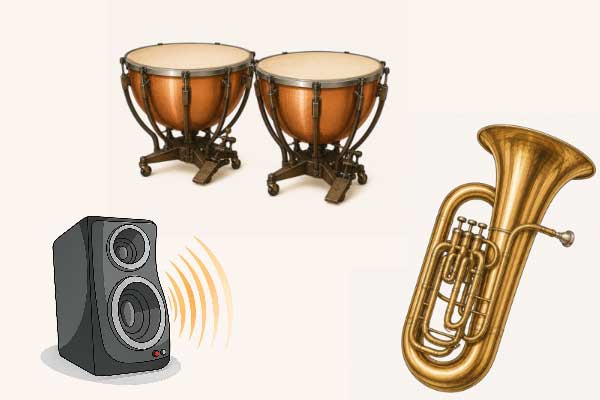
Another instrument plays it: piano, violin or flute, three very different timbres recorded note by note.
How it works
- Choose a challenge. Each round has two speakers: you must listen to both before answering, as many times as you need.
- Both versions are always the same tune, chosen at random from seven very well-known songs. So you compare how it sounds, not which song it is.
- Tap your answer. If it is wrong, the game shows the right one before moving on to the next round.
- At the end, the result is rated by the percentage of correct answers and saved in “My progress”, even for players without a name.
A review and three challenges
- Remember… Four theory questions, without sound, to review what each quality means.
- Challenge 1. The two tunes differ in only one quality: say which one.
- Challenge 2. They differ in two qualities at once: choose the right pair out of three.
- Challenge 3. They differ in three and have only one quality in common: find it.
In the classroom
- With the screen projected. A whole-class round: before answering, each pupil holds up a card or makes the gesture for the quality they think has changed.
- From theory to listening. Start with “Remember…” to fix the vocabulary and move straight on to Challenge 1, the one that gets pupils talking most about what they hear.
- Now, play it. After the game, sing or play the same song higher, louder, detached… and let the others guess which quality has changed.
- Independent practice. With headphones, each challenge takes a few minutes and progress is saved in the browser.