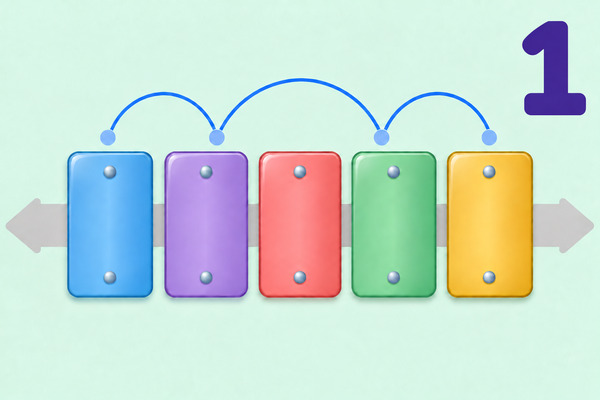
Five coloured bars sound mixed up, and you have to put them from low to high without looking at anything, just listening. It starts with wide distances, easy to tell apart, and moves towards smaller and smaller differences, down to the semitone. A direct inner-hearing exercise, in digital form.
How it works
- Five coloured bars appear out of order on the track. Tapping a bar always makes it sound.
- They have to be placed from low (left) to high (right) guided only by ear — the colour identifies each bar, never its pitch.
- Each level has 3 rounds, with a different mixed-up row each time. When you press “Check”, each bar shows whether it is in the right place, with a green or red ring — without repainting it, so the colour reference is not lost.
- “Show the correct order” puts the bars in their place so you can go through them by ear: it is the moment to learn, not just to get it right.
- A level is passed with 2 of 3 rounds perfect. The stars (0 to 3) count how many rounds were perfect.
What are cents?
A cent is the standard unit for measuring the distance between two pitches: one hundredth of an equal-tempered semitone. So a semitone is 100 cents, a whole tone 200 cents and an octave 1200. It is the unit that lets us describe precisely intervals smaller than a semitone — those that have no name of their own in Western music theory, and which are exactly what these chimes work on.
The four levels, in two sets of chimes
The difficulty is the distance between the first and the last bar: the closer together they sound, the finer the ear has to be tuned. They are split into two independent games, from easier to harder:
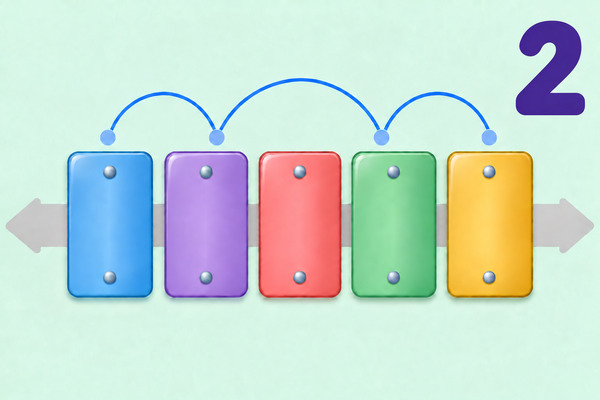
Chimes 1 has two levels:
- Level 1 — Scale. Order the diatonic scale, the one students already know. The distance between the first bar and the last is a perfect fifth (700 cents).
- Level 2 — 2 tones. The distance between the first bar and the last is a major third, two tones (400 cents): a chromatic scale in semitones.
Chimes 2 is more demanding: it enters microtonal distances, which do not appear in the music we usually hear.
- Level 1 — 1 tone. The distance between the first bar and the last is one tone; each bar is separated from the next by 50 cents.
- Level 2 — 1 semitone. The distance between the first bar and the last is one semitone; each bar is separated from the next by 25 cents.
From here on, the differences are harder and harder to tell apart by ear — a good practice order, from chimes 1 to 2.
Three ways to move each bar
With the mouse or your finger: the bar lifts, the others move aside and it snaps into place when released. It works the same on a touch screen.
Tapping a bar makes it sound and selects it; two arrows below move it one place at a time. Handy on mobile.
Tab to move from one bar to another, left/right arrows to move it, Enter to hear it.
Willems and inner hearing
Edgar Willems (1890-1978) built his music pedagogy on one central idea: music is learned first by ear, before the sign or the theory, and this ear training includes cultivating inner hearing, the ability to hear mentally what is not sounding.
To refine perception he created specific sound materials, such as chimes (sets of bells or tuned bars). Among them, the intratonal chimes, with bars separated by distances smaller than a semitone, designed to work on very small differences once the ear is ready. This game recreates that instrument in digital form: you can first try the wide distances in Chimes 1 and, when your ear is ready, tune finer with Chimes 2.
Reference: Edgar Willems, L'oreille musicale.
For the classroom
- Individually, with headphones. Each level is 3 rounds, about 5-8 minutes: perfect for an independent practice corner while the rest of the class does something else.
- As a group, with the colours as the key. The bar colours are designed for the classroom: projecting the screen, you can ask “which is the lowest, the red one or the blue one?” and let the group decide by ear before checking.
- Progression through pairs of levels. Always start with Chimes 1 (wide distances) before moving on to Chimes 2 — trying the semitone without having trained with the scale first tends to frustrate more than teach.