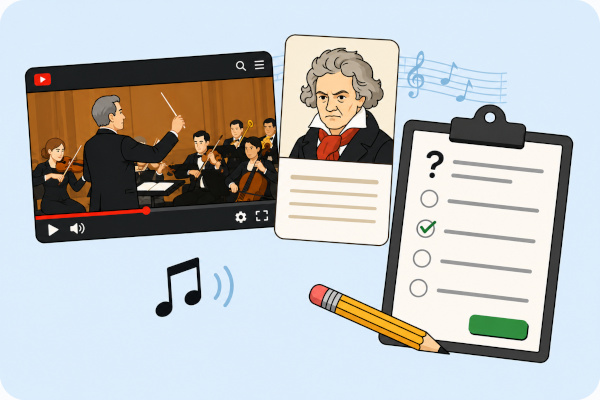
Music History Quiz reviews composers, works and periods in an enjoyable way, combining commented videos with multiple-choice questions. This guide sums up for teachers the aims, how it works and which other activities to combine it with.
Learning aims
With this activity, students:
- Recognise, by watching and listening to the excerpt, classical works representative of different periods.
- Associate each work with its composer, their nationality and its musical movement (Baroque, Classical, Romantic…).
- Expand their musical culture vocabulary: ballet, aria, soprano, symphony, soundtrack, concerto…
- Practise reading comprehension applied to a short informative text, since the questions are answered with facts from the text itself.
How the activity works
The game is organised in two phases, linked from the start screen. In each game 5 of the 6 available works are chosen at random, so two games in a row need not be identical.
The 5 chosen works are shown one by one: the YouTube video (already starting at the relevant excerpt) next to a short text about the composer and the work. You move on at your own pace with the “Next” button.
The same 5 works come back, each with its video visible again and a multiple-choice question (3 answers, random order). The correct option is marked in green and the wrong one in red, with a success or failure sound.
After the 5 questions, a result screen appears with the game's mascot reacting to the number of correct answers (from “Hmm…” to “Excellent!”, with confetti only for a perfect 5/5) and a button to play again with a new selection of works. Anyone who already knows the content can skip the Learn phase and go straight to “Questions”, using the activity as a quick assessment instead of a guided review.
Prior knowledge needed
The activity does not require reading scores or technical musical language — all the questions are answered with the information given in each work's own text. Reading comprehension suited to the stage is advisable (the text is the only source of the answers), together with some familiarity with concepts such as orchestra, composer or historical period.
Because of the vocabulary and historical references it uses, it is designed for the most advanced years of primary school — recommended from 5th grade.
For the classroom
No other game on the site needs to have been completed first. As preparation: listen in class, without giving the title, to one of the six excerpts and ask what feeling it conveys before identifying it; review on the board the basic vocabulary that will appear in the texts (orchestra, composer, century, musical movement); and place on a timeline, even roughly, the Baroque, Classical and Romantic periods.
As reinforcement after playing, each student can be asked to research and present in a couple of sentences one of the five composers studied (Tchaikovsky, John Williams, Mozart, Chopin or Beethoven) — a simple way to turn the review into their own production.