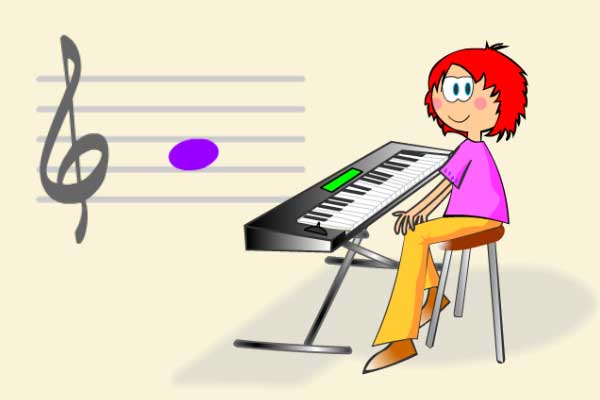
Aprendonotas is a music-reading game with three modes — Read, Write and Listen — over the same six rounds of notes in each level. Six difficulty levels, each with its own set of notes — start with the first one if you're learning, or jump straight to the level you need to review.
How to play
Within each level you choose one of the three modes and play 3 rounds of 6 notes (18 notes per game). Each note repeats until you get it right: a miss doesn't subtract anything, it just stops counting as a first-try hit. At the end, the game scores the round with two indicators, explained below: hits and fluency.
The three modes
The 6 notes of the round are shown from the start, with a cursor over the current one. You press the matching piano key before moving to the next. The most direct mode for automating each note's name from its position on the staff.
The staff appears empty and the name of the note is shown below. You click the correct line or space to "write" it — the reverse of Read, and the one that gives the game its name: placing each note in its exact spot.
The first 3 notes of the round are shown, and the last 3 stay hidden until you get them right by ear — each note plays on its own when it's its turn. Pure ear training, with no visual support in the second half of the round.
All three modes share the same set of notes for each level, but are scored separately — progress in one doesn't affect the others.
Available levels
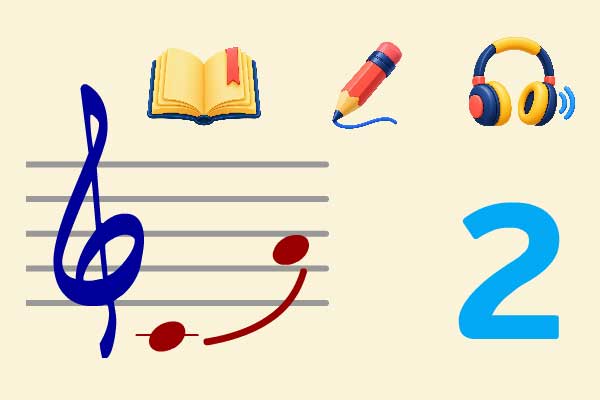
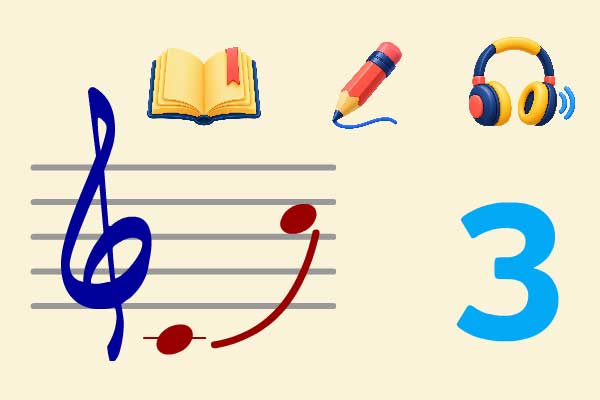


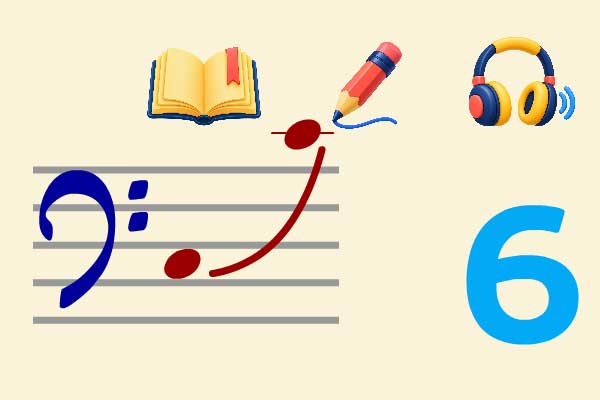
Level 1 also has two review modes: "Practise your weak notes" (the game itself picks each player's most-missed notes) and "Choose your own notes" (manual selection, useful for drilling one specific mix-up in class).
Progress and scoring
There are no points or scores to interpret. Each round is summed up in two indicators, because reading and writing music is mastered when you get it right and also do it smoothly:
Hits. How many of the 18 notes are got right on the first try, without missing beforehand. It's the accuracy measure: 18/18 means there wasn't a single mistake.
Fluency (Read and Write). Measures how fast you read or write: it's the average time of the 3 rounds, on a scale of 20 to 100 (100 means finishing each 6-note round in 4 seconds or less). It's calculated over the average of the three rounds, not the best one, because some rounds come out easier than others. Up to 3 misses in the whole game are allowed, since they can be accidental and correcting them already costs time; with more misses the game doesn't measure fluency. The result is shown with a traffic light:
Great (green), from 75, about 9 seconds per round or less, with confetti. Good (orange), from 45, about 15 seconds per round. Hmm (red), below that or with more than 3 misses: the game invites you to improve by playing again.
Listen doesn't measure fluency, because listening and reaction time would skew the measure. It's scored only by percentage of hits: 90% or more is "Excellent!" (17 or 18 out of 18, with confetti), 70-89% "Very good!" (13 to 16), 50-69% "Good" (9 to 12) and below that, "Hmm... practise again".
Moving to the next level. When fluency reaches Good or Great in Read or Write (or you reach 70% hits in Listen), the game offers a direct shortcut to the next level. It's just a shortcut: all levels are open from the start.
With a name or nickname entered before starting, progress is saved in the browser. The "Your progress" button shows, for each level and mode, the hits and fluency of the last game (with how long ago it was played) and of the best result, so you can see how things stand today and what the goal is. With an active AprendoPlus account, that progress also syncs across devices and appears in the "My progress" panel of My account.
For the classroom
The three modes fit different moments of the same session: Read to consolidate the names of notes already seen in class, Write as a more demanding check (the student has to place the note, not just recognise it), and Listen as gamified musical dictation, once Read is already solid at that level.
To work on a specific mix-up (for example, C-D at level 2), the "Choose your own notes" mode in level 1 lets you narrow the round down to just those notes, without the pressure of a full level.